Cart
0

OEM vs. Aftermarket Equipment Parts: What You Should Know Before You Buy
When a machine needs a replacement part, finding the correct component is only part of the decision.
The next question is often:
Should I buy the genuine OEM part or an aftermarket replacement?
At first glance, the choice can appear simple. The OEM part carries the equipment manufacturer’s name, while the aftermarket option may cost less.
But price alone does not tell the entire story.
Depending on the machine, component, application, and manufacturer, an aftermarket part may provide excellent value. In other situations, using a genuine OEM component can be the better financial decision, even when its initial purchase price is higher.
The key is understanding what you are actually buying.
Before choosing between OEM and aftermarket equipment parts, there are several things every equipment owner, fleet manager, technician, and parts buyer should consider.
What Is an OEM Part?
OEM stands for Original Equipment Manufacturer.
In the equipment industry, an OEM part generally refers to a component supplied through the original equipment manufacturer’s parts system and approved for use in its machines.
If you own a piece of construction equipment, for example, the OEM part may come packaged and sold under the machine manufacturer’s brand and part number.
But there is an important point that many equipment owners do not realize:
The equipment manufacturer may not have actually manufactured the part.
Most Equipment OEMs Do Not Manufacture Most of Their Own Parts
One of the biggest misconceptions in the equipment industry is that every part sold by an equipment OEM was actually manufactured by that OEM.
In reality, most equipment manufacturers assemble machines using components produced by a wide network of specialized suppliers.
Depending on the machine, those suppliers may manufacture components such as:
- axles
- transmissions
- hydraulic pumps
- hydraulic motors
- bearings
- seals
- filters
- starters
- alternators
- fuel-system components
- electrical switches
- sensors
- cooling-system components
- brakes
- hoses
- valves
- hardware
The equipment OEM may specify the component, approve it for the application, assign its own part number, place it in OEM packaging, and distribute it through its dealer network.
But that does not necessarily mean the OEM manufactured it.
In many cases, the exact same specialized manufacturer that supplies the equipment OEM also sells components through other distribution channels.
That creates an important distinction when discussing OEM versus aftermarket.
Unless a component was specifically engineered or uniquely manufactured for a particular machine, many of the parts installed at the factory are themselves products made by independent component manufacturers.
Put another way:
The equipment manufacturer is often the original purchaser of the component, not the original manufacturer of the component.
From that perspective, the term “aftermarket” can sometimes be misleading.
A transmission manufactured by a major powertrain company does not suddenly become a lower-quality product simply because it is purchased through the powertrain manufacturer’s own distribution network instead of inside a box carrying the equipment OEM’s logo.
The same principle can apply to bearings, hydraulic components, electrical parts, drivetrain components, filters, seals, and many other product categories.
What matters most is understanding:
Who actually manufactured the component?
Was it built to the correct specification?
Is it appropriate for the application?
Is it identical to, equivalent to, or different from the version supplied to the equipment OEM?
That last question is important.
Equipment manufacturers sometimes require unique specifications, materials, software, calibrations, coatings, tolerances, or other modifications.
A component that appears similar may therefore not always be interchangeable.
But in many applications, identifying the actual component manufacturer can reveal replacement options that buyers may never discover by searching only the equipment OEM’s part number.
What Is an Aftermarket Part?
An aftermarket part is a replacement component manufactured and sold outside the original equipment manufacturer’s normal parts distribution system.
However, the term “aftermarket” covers an enormous range of products.
That is why simply labeling something aftermarket tells you very little about its quality.
An aftermarket part might be produced by:
- the original manufacturer of the component
- a major global parts manufacturer
- a specialized replacement-parts company
- a reputable engineering company
- a low-cost manufacturer producing generic copies
Those are very different products, even though all of them may technically be considered aftermarket.
This is one reason buyers should be careful about assuming:
OEM = good
and
Aftermarket = inferior
The better question is:
Who manufactured the part, and what specifications does it meet?
Not All Aftermarket Parts Are the Same
This may be one of the most important things to understand when comparing OEM and aftermarket components.
There can be significant differences between aftermarket manufacturers.
Two replacement parts may look nearly identical in photographs and have dramatically different:
- materials
- tolerances
- heat treatment
- bearing quality
- seal quality
- machining accuracy
- electrical components
- quality-control standards
- expected service life
This is particularly important when purchasing parts online.
A photograph cannot tell you the hardness of a gear, the quality of a bearing race, the internal construction of a hydraulic valve, or the durability of an electronic component.
That is why the manufacturer behind the product matters.
A quality aftermarket component from an established manufacturer may perform extremely well.
An unknown component selected only because it has the lowest price may represent a much greater risk.
The Component Manufacturer May Be the Real OEM
When most people hear the term OEM part, they naturally think of the company whose name appears on the machine.
But for many components, there are really two manufacturers involved.
The equipment OEM is the company that designed, assembled, and sold the machine.
The component manufacturer is the company that actually manufactured the axle, transmission, pump, bearing, starter, valve, or other component installed in it.
In many cases, the component manufacturer may be the true original manufacturer of the part.
For example, an equipment company may purchase a transmission from a specialized powertrain manufacturer, assign it an equipment-specific part number, and sell replacement units through its dealer system.
That same powertrain manufacturer may also sell the transmission or its internal components through its own authorized distribution network.
In that situation, purchasing the component through the original component manufacturer is very different from purchasing an unknown reproduction.
It may represent the same manufacturing expertise, engineering capability, and production source that supplied the equipment manufacturer in the first place.
This is particularly relevant in areas such as powertrain, where manufacturers such as Dana and ZF produce components used across numerous equipment brands.
Understanding who actually manufactured the component can open the door to options that may offer better availability or pricing without automatically sacrificing quality.
When Does OEM Make the Most Sense?
There are situations where purchasing the genuine OEM part is often the safest or most practical choice.
1. Critical Components
Some components have a major impact on the performance or safety of the machine.
Examples may include:
- drivetrain components
- steering systems
- braking components
- structural components
- control electronics
- safety systems
- certain hydraulic components
When failure could cause extensive machine damage or create a significant safety concern, the confidence provided by a verified OEM component may justify the additional cost.
2. Equipment Under Warranty
If a machine is still covered by a manufacturer’s warranty, it is important to understand the warranty requirements before installing replacement components.
Using an aftermarket part does not automatically void every equipment warranty, but warranty coverage can depend on the circumstances, the component involved, and whether the replacement contributed to the failure.
For newer equipment, following the manufacturer’s service and repair recommendations can reduce unnecessary warranty disputes.
3. Highly Specialized Components
Some components are engineered specifically for one machine or application.
They may have unique:
- dimensions
- software
- calibrations
- communication protocols
- pressure settings
- mounting configurations
In these situations, a genuine OEM component may be the most reliable way to ensure compatibility.
4. When the Cost of Failure Is High
The price difference between OEM and aftermarket becomes much less important when the cost of downtime is substantial.
Imagine two options:
OEM component: $1,000
Aftermarket component: $750
Saving $250 sounds attractive.
But if the lower-cost component fails and results in:
- eight hours of technician labor
- a service truck call
- equipment transportation
- another replacement part
- two days of machine downtime
that $250 savings can become very expensive.
The right comparison is not simply the purchase price.
It is the total cost of the repair.
When Can Aftermarket Parts Make Sense?
There are also many situations where a quality aftermarket component can be an excellent choice.
1. Mature Equipment
As machines age, spending premium OEM prices on every repair may no longer make economic sense.
A ten- or fifteen-year-old machine that is still productive may be an excellent candidate for quality aftermarket components.
The goal becomes balancing:
Reliability + remaining machine life + repair cost
A reputable aftermarket alternative may provide exactly the right balance.
2. Common Wear Items
Many routine maintenance and wear components are available from established manufacturers.
Examples may include:
- filters
- belts
- bearings
- seals
- hoses
- certain electrical components
- hardware
- some braking components
In these categories, aftermarket manufacturers may offer products that meet or even exceed the specifications required for the application.
3. When OEM Availability Is Poor
Sometimes the biggest problem is not price.
It is availability.
An OEM component may have:
- a long lead time
- limited inventory
- backorder status
- overseas sourcing
- discontinued production
If a quality alternative is available immediately, the financial value of returning a machine to service faster can outweigh the preference for an OEM-branded component.
OEM Packaging Does Not Always Mean a Different Part
One of the more interesting realities of the equipment-parts business is that two boxes with different labels may occasionally contain components from the same manufacturer.
Consider a hypothetical bearing.
The machine manufacturer sells it as:
OEM Part 987654
The bearing itself may have been manufactured by a major bearing company and carry its own number:
Manufacturer Part XYZ123
The OEM version may travel through the equipment manufacturer’s parts distribution network.
The manufacturer’s version may travel through an industrial distribution network.
The physical component may be identical, nearly identical, or built to a slightly different specification.
That is why this should never be assumed without verification.
Equipment OEMs sometimes require unique tolerances, materials, coatings, seals, programming, or other changes that make their version different from the standard component.
The correct approach is not to assume that two parts are the same simply because they look alike.
It is to determine whether they are actually equivalent for the application.
Consider the Application, Not Just the Part
A part that performs perfectly in one application may not be appropriate in another.
Consider two machines using what appears to be the same bearing.
One operates a few hours per week.
The other operates twelve hours per day in:
- heavy dust
- high temperatures
- shock loading
- severe vibration
The operating environment changes the equation.
Before deciding between OEM and aftermarket, consider:
- machine utilization
- operating environment
- load
- duty cycle
- expected equipment life
- importance of the component
- difficulty of replacement
- downtime exposure
The best replacement for a lightly used machine may not be the best choice for a mission-critical fleet asset.
Availability Can Be Just as Important as Price
When equipment is down, an inexpensive part that arrives three weeks from now may be far more expensive than a higher-priced component available today.
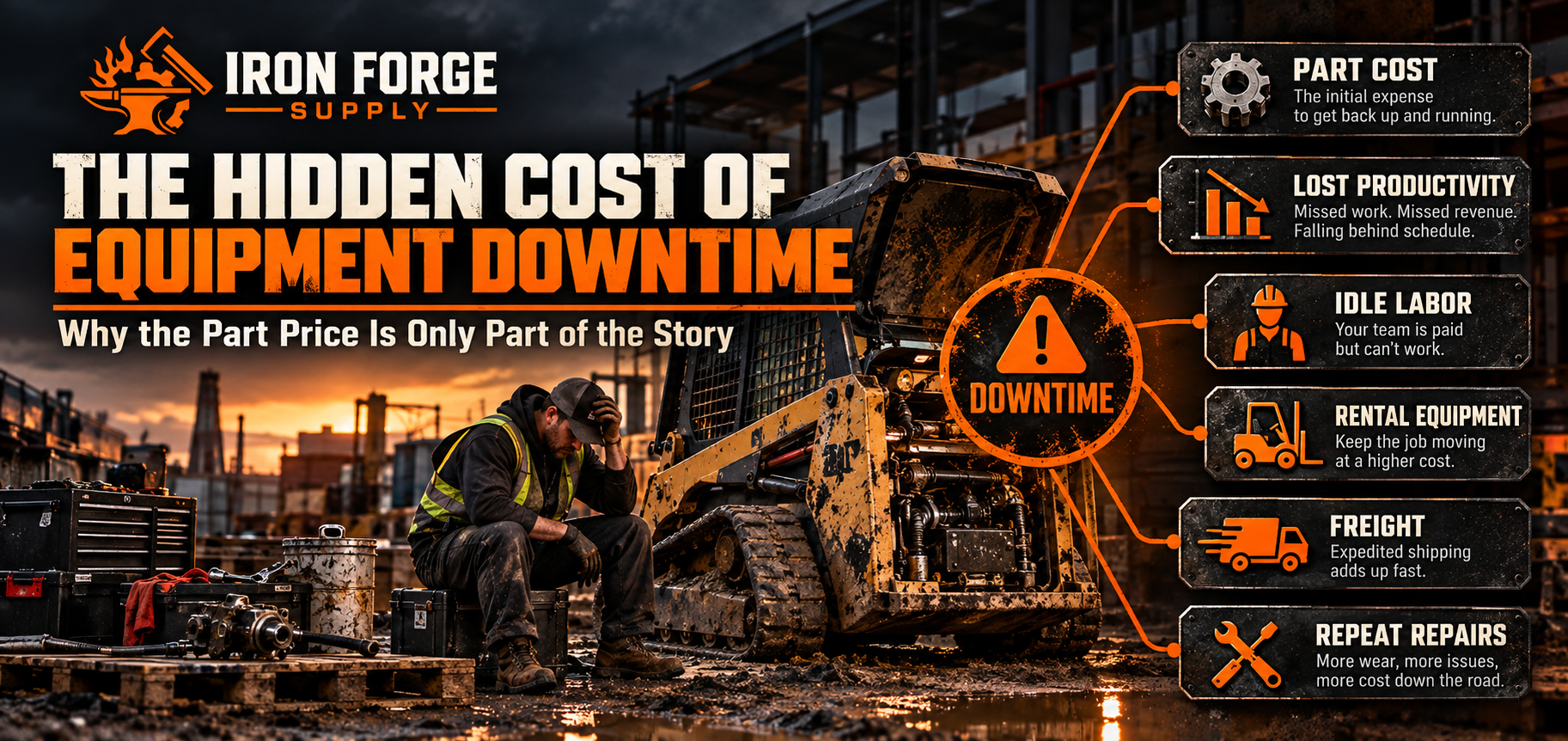
Downtime can create costs throughout an operation.
Depending on the business, those costs might include:
- idle employees
- missed production
- project delays
- replacement equipment rental
- expedited freight
- technician downtime
- lost revenue
This is why professional parts purchasing often involves balancing three things:
Price
What does the component cost?
Quality
How confident are you in its performance?
Availability
How quickly can you get the machine operating again?
The lowest number in the first category does not always result in the lowest overall cost.
Compare Warranties
Warranty coverage should also be part of the decision.
Before purchasing a replacement component, understand:
- warranty length
- what the warranty covers
- whether labor is included
- how claims are handled
- who is responsible for return freight
- whether consequential damage is covered
- what documentation is required
A slightly more expensive component backed by a strong manufacturer and distributor may provide significantly greater value if something goes wrong.
Beware of Counterfeit and Misrepresented Parts
Online marketplaces have made equipment parts easier to find than ever before.
They have also made it easier for questionable products to enter the market.
A product advertised using phrases such as:
OEM Quality
OEM Style
OEM Replacement
or
OEM Equivalent
is not necessarily a genuine OEM component.
Those phrases generally describe the seller’s claim about the product rather than its origin.
If purchasing a genuine OEM part is important, verify:
- manufacturer
- packaging
- labeling
- authorized distribution source
- part number
- product documentation
A suspiciously low price on a supposedly genuine component should warrant additional investigation.
Do Not Forget About Genuine Excess and Surplus Inventory
There is another category of parts that can offer considerable value:
genuine OEM excess inventory.
Manufacturers and distributors occasionally have inventory that becomes:
- slow moving
- overstocked
- discontinued
- associated with older equipment models
Those parts may still be brand-new genuine OEM components.
Because the inventory is no longer part of the manufacturer’s primary stocking strategy, it may become available at significantly reduced prices.
For customers maintaining older machines, genuine surplus OEM inventory can sometimes provide the best of both worlds:
OEM quality at aftermarket-style pricing.
Availability is usually limited, however. Once this type of inventory is sold, it may not be replenished.
Five Questions to Ask Before Choosing OEM or Aftermarket
Rather than automatically choosing one category, ask these five questions.
1. Who Manufactured the Part?
A recognized component manufacturer provides greater confidence than an unknown supplier.
2. How Critical Is the Component?
The consequences of a failed cabin air filter are very different from those of a failed drivetrain component.
3. How Difficult Is the Part to Replace?
If replacing the component requires ten hours of labor, reliability should carry considerably more weight in the purchasing decision.
4. How Long Do I Plan to Keep the Machine?
The ideal repair strategy for a nearly new machine may be different from the strategy for equipment nearing the end of its planned service life.
5. What Is the Real Cost of Downtime?
Sometimes paying slightly more to obtain a reliable component today is far less expensive than waiting several weeks for another option.
There Is No Universal Winner
The OEM-versus-aftermarket debate is often presented as though one side must always be better.
In reality, professional equipment maintenance rarely works that way.
There are excellent OEM parts.
There are excellent aftermarket parts.
There are inexpensive components that perform extremely well.
And there are inexpensive components that become very expensive after they fail.
The OEM-versus-aftermarket decision is also not simply a choice between a “factory part” and a “copy.”
In many cases, the equipment manufacturer did not manufacture the original component at all.
The machine was assembled using parts produced by specialized manufacturers throughout the industry.
The better question is often not simply:
“Is this OEM or aftermarket?”
It is:
“Who manufactured the part, what specifications was it built to, and is it the correct component for this application?”
Understanding that distinction can provide equipment owners with more options, better availability, and potentially significant savings without automatically sacrificing quality.
Where Iron Forge Supply Fits
At Iron Forge Supply, we believe customers should have options.
That may mean a genuine OEM component when the application demands it.
It may mean a quality aftermarket alternative when it provides better value.
It may also mean identifying the original component manufacturer, locating a superseded part number, or finding genuine excess OEM inventory that is no longer readily available through traditional channels.
Our supplier relationships and industry experience allow us to evaluate parts from more than one direction instead of simply assuming that the most expensive or least expensive option is automatically the best one.
For critical powertrain applications, Iron Forge Supply has partnered with manufacturers including Dana and ZF to provide genuine powertrain components at competitive prices.
We also continue to expand our supplier partnerships to improve availability and provide customers with more options when equipment needs to get back to work.
Need Help Comparing Your Options?
If you are trying to decide between a genuine OEM component, an original component manufacturer part, or an aftermarket replacement, provide us with as much information as possible, including:
- equipment manufacturer
- equipment model
- serial number
- original part number
- component manufacturer, if known
- photos or identification tags when available
Iron Forge Supply can help identify available options and provide the information you need to make the right decision for your equipment.
From routine maintenance to major repairs, Iron Forge Supply delivers the parts you need to keep your equipment working.ad